Lots of strange convergences over the last couple of days. My friend Paul sent me a link to a blog which explores the work of Arnold Toynbee (which I’ll get back to you about Paul!). The same day, I saw Toynbee mentioned in the book I’m currently reading – Where Man Belongs by the English inter-war rural writer and social thinker H.J. Massingham. Massingham, although spending much of his working life as a writer and journalist had some archaeological training and indeed in the same book he mentions O.G.S. Crawford, pioneer aerial photographer and founder of Antiquity. On Wednesday I got the recent and excellently reviewed new biography of Crawford by Kitty Hauser (which I hope to blog about shortly). Massingham was also closely involved in a fascinating nexus of thinkers and rural writers between the 1930s and 1950, which included Adrian Bell (father of Martin Bell), with whom he formed Kinship_in_Husbandry, a kind of proto-think tank opposed to the industrialisation of agriculture and promoting organic farming. It was one of the precursors of the Soil Association. This curious organisation straddled the traditional left/right divide and many of its founders were interested in the notions of social credit, Guild Socialism and Distributism (an economic philosophy formulated by Catholic thinkers such as Belloc and Chesterton). One of the key thinkers in Kinship in Husbandry was Rolf Gardiner, who made an appearance in yesterday’s Guardian, cited as a key figure in developing youth movements in Britain. Literary ley lines in action….
Viking York
Viking houses discovered on the Hungate site in York. Hungate has so far hit the headlines mainly as an excellent and rare example of the archaeological excavation of 19th century domestic area, with the streets, houses and backyards of the former slums of Hungate revealed. However, its important not to forget that this is York after all, and the fact that it was a major Viking city combined with waterlogging can lead to rather nice discoveries such as this.
Cambro-Canadian Epigraphy
Rather nice find from the Heather and Hillforts project in Denbighshire. Graffiti by a Canadian soldier from WWI.
Scottish wolves
The remains of a wolf trap has been discovered by archaeologists near Inverness.
Shepton Mallet chi-rho

This intriguing little item has hit the press again (e.g. The Guardian). Found in 1990 during excavations on a Roman cemetery and settlement at Shepton Mallet, it caused immediate interest as it was discovered in a grave and it is one of the very very few pieces of personal jewellery from Roman Britain bearing a chi-rho symbol. It became a highly symbolic object and was reproduced in replica form and given to the the Bishop of Bath and Wells (one George Carey).
However, there were suspicions about the authenticity of the object voiced very early. Even before tests on the metal composition in the late 1990s and this year confirmed that it was made from a modern rather than ancient alloy, several archaeologists expressed their scepticism about the item. As a Christian item found in a grave it was highly peculiar; whilst it is not unknown to find grave-goods used in a probable Christian context in the Late Antique world, it was to say the least, unusual; there were certainly no parallels in Roman Britain. It had some similarity with a brooch found in Sussex in the 19th century, but the clumsy way in which the chi-rho had been created by punched holes made for a very unsatisfactory item.
So…it does turn out its a fake, but this leads on to two obvious questions: who dunnit and why? There are a number of possible reasons; as the newspaper article notes there was much opposition to the development, and it may have been placed there in an attempt to stop the building (lets not forget that Planning Policy Guidance Note 16 did not come into operation until the November of that year). It does seem a somewhat costly way of preventing the development- there would have been the cost of the silver (admittedly probably not that much), but also the time needed to design and make it. Either the culprit had reasonable jewellery making skills themselves or they had to commission someone else to make it (which would mean more than one person was involved). Whilst the design may have been clumsy copy of the Sussex brooch, it does show that some level of research had gone into the design. The decision to plant a Christian-inspired piece is also intriguing; it shows a good eye for things that would click effectively with public opinion. This wasn’t just a quick prank, but a carefully conceived and thought-through project.
I’ve spoken to a number of people who worked on the site, they all insist it wasn’t planted at the time of discovery and that it came from a secure context (ie had been excavated from the ground and not just dropped on the topsoil). So, it must either have been placed in the soil at an earlier point, though presumably at a point after the dig had commenced and the graves identified (it would be interesting to know how much time elapsed between the initial identification of the graves and the discovery of the artefact). All in all a mystery, though in my personal opinion it must have been perpetrated by someone with at least some knowledge of Roman Britain and of archaeological techniques….
Return to blogging
After a very hectic year involving moving house, being repeatedly vomited on by Isobel, spending too much time on the A1 and generally piddling my life away on Facebook I am planning to make a return to the blog. I’ve been posting odds and sods on Facebook, but I’m going to try and start sticking them on this blog, as there is a little more room to witter. So lets get stuck in….
Fieldwork at Valle Crucis
At the end of July, myself and a group of students from University of Chester (Phil C., Brandi M., Joe M and Rachel G) spend a number of days carrying out fieldwork of the site of the old fulling mill of the Cistercian abbey at Valle Crucis, near Llangollen. This is the first stage of a joint project with Llangollen Museum to explore the site. There are no standing structural remains, but a series of earthworks related to the mill can be seen in the garden at Pandy.
We carried out an earthwork survey, which involved creating a hachure plan and levelling in a series of profiles across the site. Exploring the surrounding area I think I have also identified the course of aqueduct that took water to the nearby abbey. This will require further fieldwork though.
The next stage of the project will be small-scale fieldwork on the mill site and, ideally, further geophysical survey in the surrounding area. This will hopefully link up with geophysical survey already carried out by Sarah Semple (University of Durham)and Dai Morgan Evans ((University of Chester)in the environs of the Pillar of Eliseg.
Rotherwas Ribbon
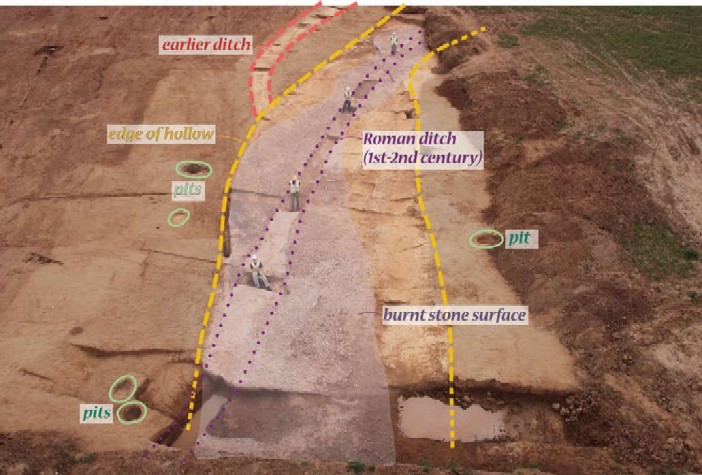
Apologies for the long delay in updating the blog. The joys of fatherhood (ie sleepless nights, projectile vomiting and constant nappy changing)and the need to complete writing my new book have meant that the blog has slipped down by ‘to do’ list.
Thanks to Bill Sheppard for passing the following on to me:
NEWS: Green Party in England & Wales
GREENS DEFEND ROTHERWAS RIBBON
A recently discovered 4000 year old monument in rural Herefordshire
is at risk of being covered by a new road development. Archaeologists
have said the 197ft (60m) long ribbon of stones, found by road
builders, could be as important as Stonehenge and is apparently
unique in Europe.
It is made up of a series of deliberately fire-cracked stones and
appears to have been deliberately sculptured to undulate through the
whole of its length that has so far been uncovered.
Hereford Green Party has been leading the campaign to defend the
Rotherwas Ribbon, also known as the Dinedor Serpent.
Local Green Cllr Gerald Dawe, said: “What we’re going to have is a
road which no-one wants, going over a part of our history which has a
lot of public support.
Green Party Principal Speaker Dr. Derek Wall said:
“The Rotherwas Ribbon is of great historical importance. It is vital
that discoveries like these are protected from more road building.
“English Heritage inspectors have said that the best thing is for the
remains to be preserved in-situ. They are currently considering
whether the site meets the criteria for ‘scheduling’ – this status is
given to monuments whose preservation is given priority over other
land uses. (1)
“Though this wouldn’t preclude the relief road being built, it would
send a message to Hereford council of the importance of these ancient
remains.
“A petition calling for a full public inquiry to decide the future of
the Rotherwas Ribbon can be signed on the Downing St website. I urge
people who care about out archeological heritage to add their names.(2)
“There are many organisations fighting effective and vital campaigns
against road building around the UK – including Road Block and the
Group Against Motorway Expansion.” (3)
ENDS
Notes for Editors
(1) More information on the Scheduling of Monuments can be found at
http://www.english-heritage.org.uk/server/show/conWebDoc.2436
(2) http://petitions.pm.gov.uk/rotherwas/#detail
(3) More info on Road Block can be found at http://www.roadblock.org.uk
More info on Group Against Motorway Expansion – http://
nom6e.blogspot.com/
Green Party Press Office
020 7561 0282
http://www.greenparty.org.uk
Published and promoted by Jim Killock for the Green Party, both at
1a Waterlow Road, London N19 5NJ.
The destruction of Saami forests in Finnish Lapland started again
Forwarded from Taiga-Info
Here is some new information on the situation in Finnish Lapland, where the
Finnish Forest and Park Service recently resumed logging in one of the
important reindeer winter grazing areas.
Hannu Hyvönen at independent Finnish media cooperative Signs of life has
compiled this information. You can reach Hannu directly at
hannu@elonmerkki.net
The destruction of Saami forests in Finnish Lapland started again
The long lasting forestry conflict in Finnish Lappland is again in a very
urgent state. The Finnish state owned company, Metsähallitus,
has started large scale logging operations in the home area of indigenous
Saami people on the 14th of May, 2007.
These logging have been critisized for the following reasons:
-there is no solution yet for the land ownership conflict between
indigenous Saami
people and the Finnish state.
-the Finnish state has not proven to be the actual owner of the forests
that it is logging right now.
-the clear-cutting style of logging ancient forests in the extreme north
of Europe cannot be accepted from an ecological and micro-climatical point
of view.
-the loggings destroy the very basis of the culturally important Saami
free grazing reindeer herding tradition
-the loggings waste the ancient forests and its wood and leave less
possibilities for future truly sustainable continuous cover forestry
without destructive clear cutting.
Among others Union of Ecoforestry urged Finnish
parliament to stop the logging immediately and distributed for
parliament groups the documentary movie Last yoik in Saami forests
(http://elonmerkki.net). Until now there has not been any public reaction
by the Finnish government. The silence in Finnish media also continues.
The director of the movie, Hannu Hyvönen, expressed his feelings about the
on-going loggings recently: “It is quite easy for us to update this sad
turn-up in the documentary movie, but we cannot update these forests which
are now again cutted down.”
The documentary movie can also be loaded here:
http://video.elonmerkki.net/last_yoik.mp4
More info and links:
http://elonmerkki.net
The short history of this conflict with video clips from the movie
==================================================================
1. Centre of Saamiland
In northern Lapland, over one thousand kilometres north of Finland’s
capital, Helsinki, lies the largest remaining wilderness in Western
Europe. These fells and forests are the homeland of Northern Europe’s only
indigenous people, the Saami. The land rights issue in the Saami homeland
is unsolved.
Look the introduction of the scenerys videoclip
http://video.elonmerkki.net/videoreportage/alkumaisema.mp4
2. Pulping the Saami forests?
Traditional reindeer herding is the one essential basis of
Saami culture.
During the cold Arctic winter months, old-growth forests provide a
lifeline for grazing reindeer. On the old trees grows the arboreal hanging
lichen that is an essential wintertime food for the reindeer.
However, the Finnish state-owned forestry company, Metsähallitus is
destroying important winter grazing forests that are vital to the
reindeer. These old-growth forests are harvested for production in the
Finnish pulp and paper industry.
Look the forestry yoik of the movie Last yoik in Saamiforests:
http://video.elonmerkki.net/videoreportage/metsatalousjoiku.mp4
3. Who owns the land?
One big and still unsolved issue is the ownership of these forests.
Finnnish state cannot prove its ownership and still continues
logging activities. Look the comment of Heikki Hyvärinen, the lawyer of
Saami parliament
http://video.elonmerkki.net/videoreportage/varas.mp4
4. Greenpeace arrive
The long-lasting conflict between Saami reindeer herding interests and
government-owned industrial forestry flared up in the spring of 2005.
Local Saami reindeer herders joined environmental organizations and
started an international campaign to save the reindeer grazing forests
from logging.
Look the interview in the camp:
http://video.elonmerkki.net/videoreportage/gp%20tulee.mp4
5. Cutting break and Antiterror infocenter
Greenpeace contacted the paper buyers. Forest industry giant Stora Enso
decided soon to stop buying wood from the disputed forests.
Metsähallitus had to stop the logging.
The conflict escalated towards violence when forestry workers, supported
by the Finnish government forestry company, set up their “anti-terror”
camp next to the Greenpeace Forest Rescue Station in the disputed forests.
They started attacks in the Greenpeace camp in nights
and days.
http://video.elonmerkki.net/videoreportage/logging%20break%20and%20alqaida.m
p4
http://video.elonmerkki.net/videoreportage/loggersjoik.mp4
In May 2005 cutting moratorium continued and Greenpeace moved avay their
camp to cool down the atmosphere.
6. Stora Enso and Metsähallitus started loggins again in June 2005
But in July Stora Enso announced to their customers to start the
wood buying again and Metsähallitus started their cuttings in the area of
Nellim reindeer herders.
Look the clip of the scenerys from Inari lake:
http://video.elonmerkki.net/videoreportage/inaria.mp4
7. United Nations intervention
In November 2005 reindeer herder Kalevi Paadar with his brothers made a
complaint for UN Human Rights Committee and claimed that cuttings in their
village destroy their possibilities continue the traditional free crazing
with reindeers and so violate their Saami rights for manage own culture.
UN Human Rights Committee asked Finland to stop cuttings for further
researches.
Look the video:
http://video.elonmerkki.net/videoreportage/kalevi-YK.mp4
8. Illegalism in Lapland
The cuttings were stopped but the dialogue did not continue. The prime
minister did not want to join in discussion and the chair of Finnish
Secret Policy accused Greenpeace to be a violent terrorist organization:
http://video.elonmerkki.net/videoreportage/supo%20ja%20terroristit.mp4
>From the Saami side the conflict was not seen caused by Greenpeace but
Finnish companies wasting the forests and wasting the wood of them. Look
the comment by Pekka Aikio, the president of Saami Parliament in Finland:
http://video.elonmerkki.net/videoreportage/aikio.mp4
9. Cuttings continue in June 2007
The present situation is now hot againg. Metsähallitus started logging in
Saami forests in Kessi in May 2007.
Read more and look the photos on the areas:
http://weblog.greenpeace.org/forestrescue/
============================================================================
===================================
LAST YOIK IN SAAMI FORESTS – A DOCUMENTARY FOR UN
The above clips are part of the documentary movie
Last yoik in Saami forests , 54 min
You can look the version updated April 2007 on the address:
http://video.elonmerkki.net/last_yoik.mp4
The documentary movie is also available on DVD.
For commercial presentations, library use and for tv broadcastings, please
contact the director Hannu Hyvönen directly at hannu@elonmerkki.net
Contacts:
info@elonmerkki.net
tel +358 40 831 7733
New arrival

Isobel Kathleen Petts finally made her long-awaited appearance on Sunday May 20th at 5.36pm (just in time for Antique’s Roadshow). Yay!
 Outlandish Knight